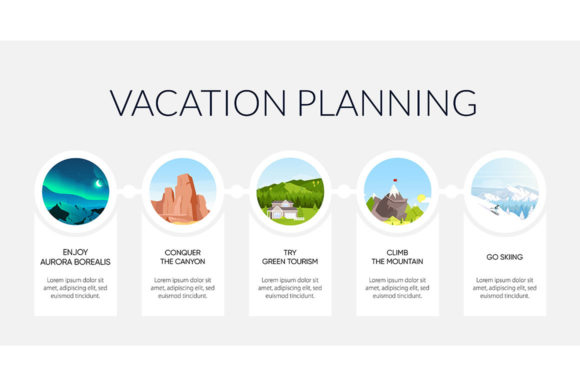
Vacation Planning Flat Color Vector Design Guide
Visual communication in the travel industry requires a delicate balance between inspiration and information. When designing for active tourism, the aesthetic must convey energy and movement without overwhelming the viewer with clutter. A vacation planning flat color vector serves as an essential foundation for this specific design challenge. Unlike photorealistic imagery that can sometimes feel static or overly commercial, flat vector art offers a stylized, approachable, and highly adaptable visual language. This style strips away unnecessary gradients and shadows, focusing instead on bold shapes, vibrant palettes, and clear silhouettes that communicate concepts instantly across digital and print mediums.
The utility of a vacation planning flat color vector lies in its scalability and editability. Whether you are creating a massive advertising banner for a travel expo or a compact icon set for a mobile booking app, vector graphics maintain perfect crispness at any resolution. For designers and marketers, this means a single asset library can support an entire multi-channel campaign. The included formats—EPS, AI, SVG, PNG, and JPG—ensure compatibility across professional design software like Adobe Illustrator and accessible tools like Canva or PowerPoint. This technical flexibility allows creators to focus on narrative and layout rather than worrying about pixelation or file conversion issues.
Elevating Active Tourism Narratives
Active tourism differs significantly from passive relaxation. It involves hiking, cycling, water sports, and cultural immersion. Capturing this dynamism through illustration requires intentional composition. Cartoon landscapes within these templates should not look childish; rather, they should utilize simplified geometry to emphasize scale and activity. When adapting a vacation planning flat color vector for this niche, consider how character placement interacts with the environment. A hiker silhouette positioned against a stylized mountain range creates an immediate sense of adventure that stock photography often fails to achieve authentically.
Color psychology plays a pivotal role in this context. Flat design relies heavily on color to create depth and mood since texture is minimal. For active tourism projects, move beyond generic tropical blues and sunset oranges. Incorporate earthy greens, slate grays, and energetic accent colors like terracotta or mustard yellow to signal outdoor exploration and sustainability. These palettes resonate with modern travelers seeking authentic experiences over manufactured resorts. By customizing the vector colors to match specific regional landscapes or brand identities, designers can create bespoke visuals that feel grounded and purposeful.
Strategic Applications Across Formats
The true value of an informational infographic template emerges when applied strategically across different touchpoints. Each format demands a unique adaptation of the core vector assets to remain effective.
- Advertising Flyers and Leaflets: In print marketing, hierarchy is everything. Use large vector illustrations as the primary focal point to grab attention within seconds. Keep text concise and let the cartoon landscapes do the heavy lifting regarding atmosphere. Ensure bleed areas are properly set up in the AI or EPS files to prevent white borders during trimming.
- Presentation Decks (PPT): Travel pitches often suffer from text-heavy slides. Replace bullet points with visual metaphors derived from the vector set. A timeline of a vacation itinerary can be represented by a winding path through a landscape illustration rather than a standard Gantt chart. This maintains audience engagement while conveying complex logistical information clearly.
- Digital Info Banners: Web and social media banners have strict aspect ratios and limited safe zones. SVG versions of vacation planning vectors are ideal here due to their small file size and responsiveness. Design with negative space in mind to accommodate overlay text and call-to-action buttons without obscuring key illustrative elements.
- Booklets and Brochures: Long-form content benefits from consistent visual threading. Use recurring vector motifs—such as specific tree styles, cloud formations, or character designs—to guide readers through sections. This creates a cohesive narrative flow that makes dense information digestible and visually pleasing.
Customization for Audience Relevance
A template is merely a starting point; relevance comes from thoughtful modification. Different audiences respond to distinct visual cues. Families planning summer trips may prefer softer rounded shapes and warmer tones that suggest safety and fun. Conversely, solo backpackers or adventure seekers might respond better to sharper angles, higher contrast, and more rugged landscape interpretations. Marketers and bloggers must analyze their demographic before finalizing designs. Simply changing the color profile and swapping out a few iconic elements within the vector file can shift the entire tone from "family-friendly resort" to "extreme wilderness expedition."
Educators and content creators can leverage these assets to teach geography, culture, or travel logistics. Flat color vectors are excellent for educational materials because they reduce cognitive load. Complex topographical maps can be simplified into readable infographics that highlight trails, elevation changes, and points of interest without the noise of satellite imagery. When using these templates for instructional purposes, prioritize clarity over decoration. Labeling systems should integrate seamlessly with the illustration style, using typography that complements rather than competes with the artwork.
Maintaining Professional Consistency
One common pitfall when working with pre-made vector packs is inconsistent styling. Mixing assets from different sources can result in a disjointed final product. To maintain professionalism, treat the downloaded ZIP file as a comprehensive design system. Before beginning a project, audit all available elements to understand the stroke weights, corner radii, and color values used throughout the collection. If you need to draw additional custom elements to fill gaps, strictly adhere to these established parameters.
Organization is equally critical for efficiency. Rename layers logically within your design software. Group related elements such as foreground foliage, background mountains, and sky elements separately. This structural discipline saves hours when making client revisions or adapting layouts for different sizes. For freelancers and agencies managing multiple travel clients, creating a master library of customized vacation planning flat color vector assets can significantly accelerate production timelines while ensuring high-quality output.
Practical Inspiration for Real Projects
Creativity thrives within constraints. Instead of viewing the template as a rigid framework, see it as a modular kit. Consider a travel agency promoting eco-tourism in Costa Rica. Rather than using generic jungle clipart, combine the flat vector trees with topographic line work to emphasize terrain difficulty. Add semi-transparent overlays to create depth without abandoning the flat aesthetic. Pair this with clean sans-serif typography and ample white space to evoke a sense of calm organization amidst nature.
For entrepreneurs launching a glamping business, the same vector assets can be repurposed to highlight amenities. Scale up tent illustrations and surround them with stylized flora to create site maps that double as decorative wall art in reception areas. This dual-purpose approach maximizes ROI on design assets. Similarly, travel bloggers can use individual vector elements as featured image backgrounds, ensuring visual consistency across hundreds of posts while avoiding repetitive stock photo licensing fees.
Ultimately, successful design solves problems. A vacation planning flat color vector is not just decoration; it is a communication tool. It translates abstract travel concepts into tangible visual promises. By understanding the technical capabilities of vector formats and applying strategic thinking to composition and color, creators can produce work that inspires action. Whether crafting a simple leaflet or a comprehensive digital campaign, the goal remains constant: to make the promise of adventure feel accessible, organized, and undeniably appealing. Invest time in mastering these assets, and they will serve as a reliable foundation for countless future creative endeavors.